
THE END OF OAK STREET is not just an awesome summer blockbuster; it’s also a movie featuring a queer coming-of-age story. And while it isn’t maintext, it’s hardly subtext either. This story made my gay little 1980s-loving heart soar. Read more about the LGBTQ character in The End of Oak Street here!
First of all, this feature will include minor spoilers for The End of Oak Street. Not about the actual dinosaur survival plot, but rather one character in particular. Consider yourself warned.
Looking for a spoiler-free The End of Oak Street movie review by a gay woman? I’ve already released one here >
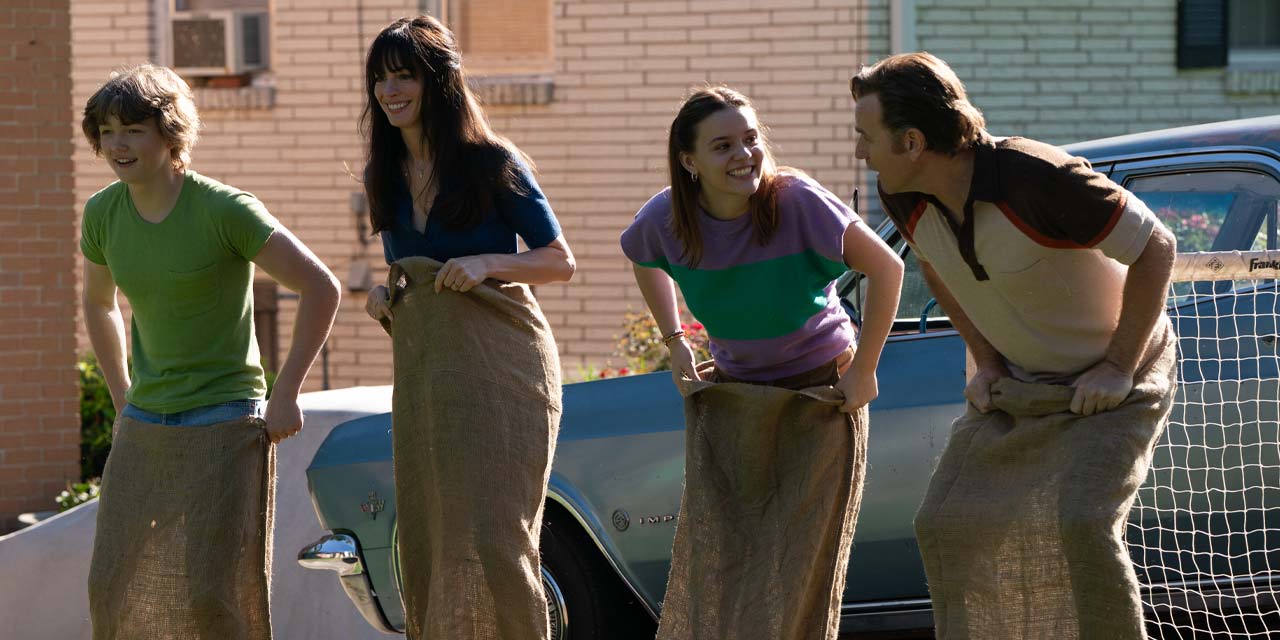
Now, let me get back to the main story: The gay character in this new and wonderful movie starring Anne Hathaway, Ewan McGregor, Maisy Stella, and Christian Convery as the Platt family.
In case you forgot, there was also queer representation in the Jurassic World: Dominion movie, which we covered here >
Okay, now it’s all about The End of Oak Street…
The gay daughter in The End of Oak Street
The LGBTQ coming-of-age story in The End of Oak Street is all about the teenage daughter in the movie. Her name is Audrey, and she’s the oldest child in the household.
Her character is portrayed by Maisy Stella, who many LGBTQ people may recognize from My Old Ass. She played the younger version of Aubrey Plaza‘s character, who was also queer. In fact, she was very much out and proud, but that movie also played out in the present.
The End of Oak Street does not. It’s set in 1982, which was not a time when coming out (or being out) was particularly easy. Sure, it was getting better, but that all depended on where you lived, who you were around, and what your family believed.
Another detail about Audrey is that she is very interested in STEM, wants to go to Cornell because her hero, Carl Sagan, teaches there, and is always reading a book or looking at the sky. Her character would definitely have been a boy if this movie had been made in the 1980s.
Maybe that’s why I love this movie so much: It’s full-on 1980s, but has details that you would never have seen in a movie made in the 1980s. Also, the soundtrack is amazing, which I will get back to, as the first queer clue I noticed involved an iconic song.
The fierce lioness in The End of Oak Street
In The End of Oak Street, the real powerhouse of the family is Denise, the mother portrayed by Anne Hathaway. She is a brilliant woman, a fierce mother, and when there’s a shotgun, she is the one to pick it up. Little details, like showing an older picture of Denise standing proudly with a weapon, let us know that she’s the expert in the area.
As it turns out, she’s the expert in a lot of areas. Her husband, Greg (Ewan McGregor), is trying to be the kind of husband that he feels is expected. However, somewhere along the line, he seems to have forgotten that he married a very capable woman.
The events happening in this movie will soon remind him, and it’s a realistic take on how people can find each other again. Not saying it’s all rainbows and lollipops, but they suddenly see each other again.
Watching this movie in the theater, I just saw Anne Hathaway portraying Denise as this amazing lioness of a mother. She would protect her family, but also expected them to be smart themselves. Ewan McGregor is good in this movie; Anne Hathaway is the kind of mom we all knew in the 1980s, but rarely saw in a Hollywood movie.
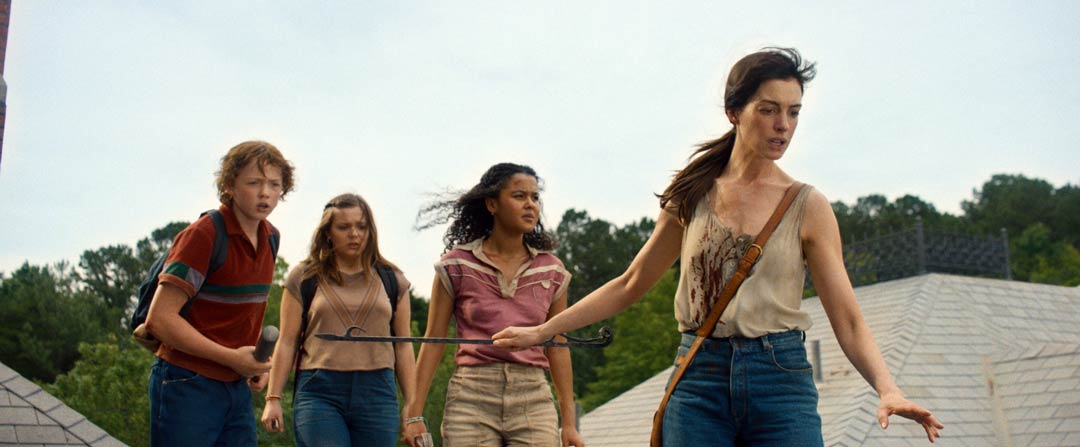
Pay attention to the details…
When I’m watching The End of Oak Street again, and I definitely will, I plan on paying even more attention to the details. I have no doubt I missed something in the beginning of Audrey’s story.
Like when she’s looking at a boy and girl her own age kissing. Is she looking at him or her? Who does she want to be kissing?
Well, for me, the answer became apparent shortly after the big event that leads their entire neighborhood to suddenly be in a tropical climate full of dinosaurs. None of her friends are there, and she is clearly missing someone.
She goes to the family car, parked in the garage. There, she plays the Steve Winwood song “Valerie” on the car stereo cassette player.
Wait, isn’t that an error? Oh yes, it is…
The song “Valerie” was recorded in 1981, but not released as a single until October 1982, and The End of Oak Street takes place in the summer of 1982. The song is from the album “Talking Back to the Night”, which was released on August 2, 1982.
The story plays out in July or June. I forget which, but it’s made very clear in the movie, and it was not August yet.
That means writer-director David Robert Mitchell wanted to include this song for that scene so badly that he ignored this error.
Just sayin’!
Oh yes, my gaydar was going off
Anyway, as Audrey sits in the parked car, gripping the steering wheel and singing along, I turned to my wife in the theater and whispered: “She’s singing about the girl”.
When I tell you that my stomach was suddenly full of butterflies as I felt like I was watching myself at that same age, I am not exaggerating. Okay, I would’ve been her age in the 1990s, not 1982, but I listened to those same 1980s songs.
The lyrics playing were:
“So wild, standing there
With her hands in her hair
I can’t help remember
Just where she touched me
There’s still no face
Here in her place
So cool, she was like
Jazz on a summer’s day
Music, high and sweet
Then she just blew away“
I just kept noticing how clearly she was saying “She” and how there was so much longing there. Again, I recognized this feeling.
Anyway, my wife didn’t quite catch on, but accepted that it was possible. She often tells me: “You think everyone is gay!” to which I reply: “Because the world assumes everyone is straight.” Anyway, in the case of The End of Oak Street, it will become more evident that I was right.
For the record, I am rather often right, because I do have excellent gaydar.
Ahhh, young love… in a world of dinosaurs
The real “proof,” if you will, came when a character we had only seen in passing earlier joins the Platt family. A girl, Jeanette (Jordan Alexa Davis), who just moved into the neighborhood, is on her own in this new dinosaur-filled world of dread.
The Platt family takes her in, and as Audrey is tending to a cut on Jeanette’s leg, there is that lingering eye contact from both. Then comes that smile of recognizing what kind of look they are both giving to the other.
As an added bonus, the younger brother, Brian (Christian Convery), had seen Jeanette just before the dinosaur-inducing event, and was clearly very interested in her. When he tries to get involved with the conversation between Andrey and Jeanette, there is no reaction from Jeanette, who just keeps looking at and talking to Audrey.
The camera focuses on Brian’s face as he comes to the realization that the audience should also have come to by now; Jeanette is not interested in me, but she clearly is interested in my sister.
YOUNG QUEER LOVE… WITH GHOSTS?
Another huge Hollywood movie teasing an LGBTQ coming-of-age plot was this one >
From this point on, there is virtually not one single scene with both Audrey and Jeanette without showing them holding hands. They are constantly together, worried about each other, and holding on to each other.
This is young love in a world full of confusion from dinosaurs rather than their feelings. In fact, they both know what they’re feeling; the struggle is with the place they’re in, not them.
Bottom line: You should watch The End of Oak Street because it’s an awesome summer blockbuster. However, you should expect your gay little heart to soar a little extra at times thanks to Audrey’s story.
The End of Oak Street is out in U.S. theaters from August 14, 2026.